
Ground Loops: Why Audio Hum Happens and How to Stop It
In professional audio environments, a persistent, low-frequency hum can compromise even the most sophisticated systems. This phenomenon, known as a ground loop, is a common technical challenge that engineers must identify and resolve to maintain signal purity.
Well-designed connectors and cables help preserve signal integrity by reducing susceptibility to noise and interference. Understanding how ground loops occur helps guide the use of appropriate mitigation techniques in professional audio systems.
The Problem Engineers Hear First

Ground loop problems are often identified by ear before they appear on a meter. The most common symptoms are related to the frequency of the AC power that feeds the equipment. Electrical power is delivered as an alternating current that oscillates at a fixed rate: 60 Hz in North America and 50 Hz in many other parts of the world. When this energy leaks into the audio path, it becomes audible.
Hum: A steady, low-frequency tone at 60 Hz or 50 Hz, matching the mains power frequency for the region. Because this frequency is low and continuous, it is usually perceived as a smooth, constant hum.
Buzz: A harsher, more complex sound made up of multiples of the mains frequency, such as 120 Hz, 180 Hz, and higher. These harmonics are often introduced or emphasized by modern switching power supplies, LED lighting, or dimmers, which distort the original power waveform.
These noises tend to become obvious as soon as a fader is raised, especially in high-gain signal paths like microphone preamplifiers or guitar amplifiers.
What a Ground Loop Really Is
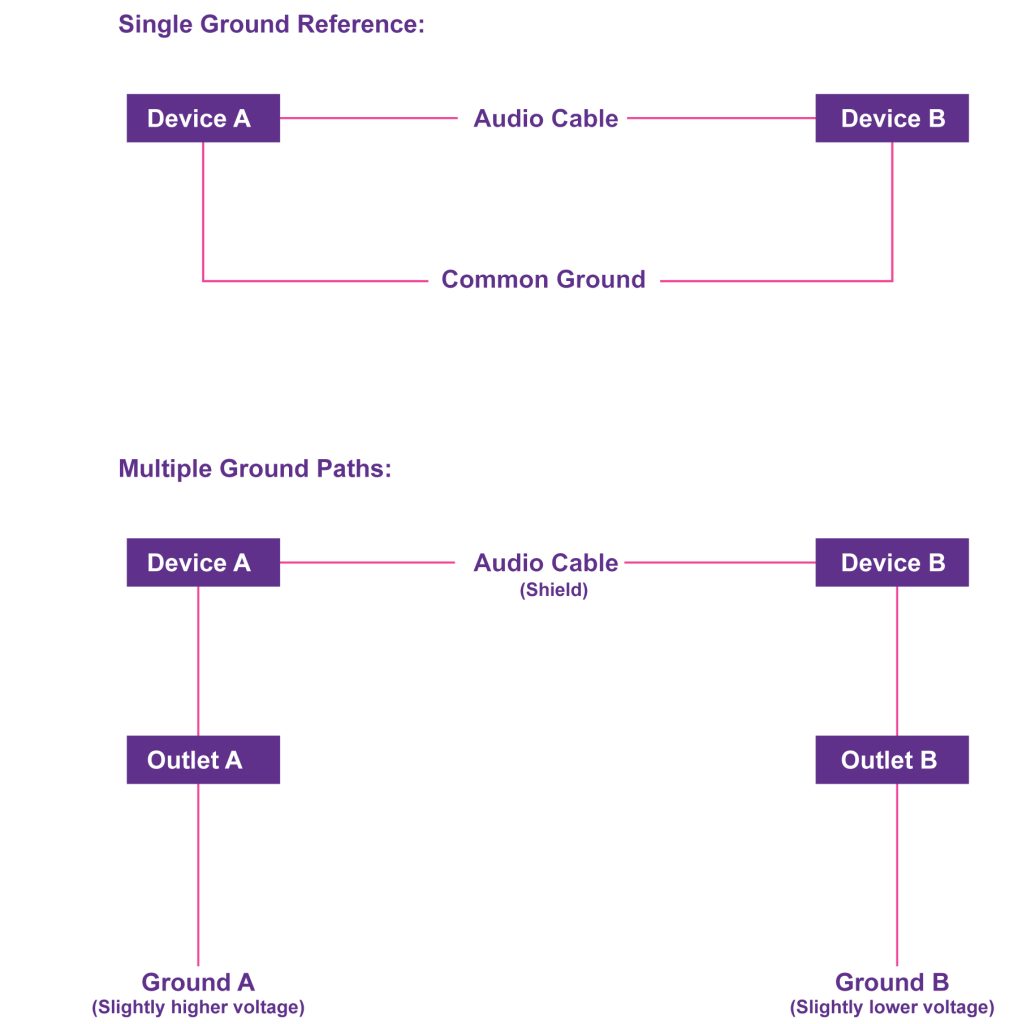
In a perfect world, all your equipment shares a single, clean path to the electrical ground. However, a ground loop occurs when there is more than one path to ground between two pieces of equipment.
This happens because ground itself isn’t always at zero volts. Different power outlets can have slightly different ground potentials due to resistance in cabling. When you connect two devices together that are powered from different outlets, that cable becomes a bridge between the two ground systems. The electrical current, seeking the path of least resistance, flows through your signal cable’s shield to get from the higher-potential ground to the lower-potential ground.
Why Audio Systems are Especially Sensitive
Audio systems are more affected by ground-related noise than many other types of equipment. This comes down to how audio signals are created, amplified, and transported.
Low-Level Analog Signals
Many audio sources, especially microphones, generate extremely small electrical signals. These signals can be only a few millivolts. Because the audio voltage is so low, even a small amount of unwanted current on the ground or cable shield can be similar in size to the signal itself. When that happens, the noise becomes part of what you hear.
High Gain Stages
To make those small signals usable, audio systems rely on high-gain amplification. A microphone preamp may apply 40 to 60 decibels of gain, or more. This amplification does not distinguish between the desired signal and unwanted noise. Any hum or buzz introduced earlier in the signal path is amplified right along with the audio, making ground-related problems much more noticeable.
Long Cable Runs
In studios, venues, and installed systems, audio cables often run long distances between rooms, racks, or stages. These runs may pass through areas powered by different electrical circuits or panels. As cable length increases, so does the chance that the connected equipment will reference slightly different ground voltages. The longer the cable, the more opportunity there is for ground current to flow through the shield and interfere with the signal.
Why Digital and Line-Level Signals Are More Tolerant
Not all audio signals react to ground noise in the same way. Compared to microphone-level analog signals, line, speaker and digital signals are generally less sensitive to ground-related interference.
Higher Signal Levels
Line-level signals operate at much higher voltages than microphones. Because the audio signal is stronger, small amounts of ground noise are less likely to compete with or mask the desired signal. In practical terms, the noise is still present, but it is often far enough below the signal level that it is not audible.
Lower Gain Requirements
Line-level sources typically require little to no additional gain. Since the signal is not being amplified as aggressively, any noise picked up along the way is not boosted to the same degree as it would be in a high-gain microphone path.
Digital Signal Transmission
Digital audio systems transmit binary data signals rather than a continuously varying analog waveform. As long as the ground noise does not exceed the threshold where bits are misread, the signal remains intact. Small amounts of ground-related noise that would be clearly audible in an analog system may have no audible effect at all in a digital one.
Why Microphones Reveal Problems First
Because microphones combine very low signal levels with high gain and long cable runs, they are often the first place where ground loop issues become audible. If a system is quiet at the microphone inputs, it is usually quiet everywhere else.
Common Real-World Causes
Ground loops rarely come from a single fault. They usually appear because of how equipment is powered and interconnected in real environments.
Different Power Outlets
Using different outlets for interconnected equipment is one of the most common causes. For example, a mixer powered from an outlet at front of house and powered speakers plugged into outlets on stage may be connected to different electrical circuits or panels. Even though both outlets are grounded, they may not be at exactly the same voltage.Buildings may also have outdated or compromised grounding systems that otherwise go unnoticed in daily life. When audio cables connect the equipment, the difference in ground potential causes current to flow through the cable shields, which becomes audible as hum or buzz.
Computers and Vehicle Electrical Systems
Computers and vehicles are electrically noisy environments. PCs contain switching power supplies, processors, and USB subsystems that generate wide-band electrical noise. Vehicles add additional complexity with alternators, ignition systems, and shared chassis grounds. When audio equipment is connected to these systems, the noise can easily couple into the audio path through ground connections, often resulting in loud and unstable interference.
Cable Shields Carrying Current
In unbalanced connections, such as TS instrument cables, the cable shield serves two roles: it provides shielding and acts as the signal return path. If ground current flows through the shield, that current is directly summed with the audio signal. This is why unbalanced systems are especially sensitive to ground loops and why even small grounding issues can become clearly audible.
How Product Design Helps Prevent Loops
Audio equipment can be designed to reduce or eliminate the effects of ground loops through several strategies:
Balanced Inputs and Outputs
Balanced connections use two signal wires and a separate ground or shield. The receiving device compares the two signals and amplifies only the difference between them. Any noise or hum that appears equally on both wires is effectively canceled out, keeping the audio clean. Often, balanced connections can work without the ground return line, so it can be disconnected using a switch to eliminate a ground loop path. Common connectors for balanced connections include XLR and TRS cables.
Careful Internal Grounding
High-quality equipment separates signal ground from chassis ground, carefully controlling where they meet. Typically, the chassis and signal ground connect at only one point. This approach reduces unintended current paths that could carry hum into the audio signal.
Ground Isolation
Some devices use transformers or other isolation methods to physically break the direct electrical connection between components while still allowing the audio signal to pass. This prevents ground currents from traveling through the signal path, eliminating the hum before it can reach the amplifier or mixer.
What Engineers Can Do During Integration
Ground loops are a common challenge, but with careful planning and good practices, they can be managed effectively. Here are the key steps engineers can take during system setup:
Power Distribution
Whenever possible, connect all interdependent equipment to the same electrical circuit or power strip. Keeping devices on the same circuit helps equalize ground potential and minimizes the likelihood of stray currents flowing through audio cables.
Cabling Best Practices
Use well-shielded, high-quality cables for all audio connections. For balanced connections like XLR, ensure the cable shield connects to Pin 1 at both devices, rather than to the connector shell, to prevent the common issue where the shell housing unintentionally carries current but might be disconnected in some equipment. Proper cabling can significantly reduce the risk of ground-induced noise.
Field Diagnosis
If hum or buzz is present, a methodical approach helps locate the source. Disconnect input cables one at a time while listening to the system. When the hum disappears, you’ve identified the path creating the ground loop. Devices such as DI boxes with a ground-lift switch or transformer magnetic isolators can then safely interrupt the loop without affecting signal integrity.
Final Thought
Ground loops can be frustrating, but they are not mysterious. By understanding how current flows through interconnected equipment, keeping power distribution organized, and using balanced connections with proper grounding practices, engineers can ensure that unwanted hum or buzz never reaches the audience. The result is a cleaner, more reliable system where the performance, not electrical noise, takes center stage.